Dew-Point in Compressed Air
|
Dew-Point Measurements in compressed air are vital for safety, quality and efficiency purposes. | |
 | |
For 40 years Michell has been the leading supplier of dew-point sensors and portable moisture spot check instruments for moisture content on ISO 8573-1 Class 1,2 and 3 compressed air dryers. As moisture specialists owning 5 dew point technologies, we understand the needs of the compressed air user to provide suitable solutions for specific applications. Accurate and stable Dew-Point Measurements in Compressed Air provide many benefits:
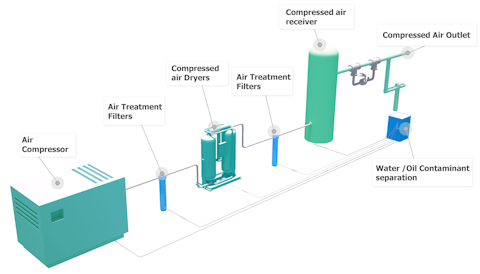
There are different industries where dew-point measurements are vital to ensure safety and efficiency and each sector requires different levels of air quality. The most common uses for dew-point sensors and measurements in compressed air are below: |
  |
Dew-Point Measurements in Instrument Air Compressed air used to power pneumatic tools and conveyers must be clean and dry to avoid contamination of products and corrosion of the equipment. The ISO Air Quality Standard ISO8573-1 is the international standard which sets out the requirements for compressed air purity and covers particulates and oil as well as moisture contamination.
For class 2 compressed air, a pressure dew point (PDP) of -40°C (-40°F) or better is required and no liquid water is allowed. Dew-Point Measurements in Breathing Air High levels of moisture in breathing air makes it uncomfortable to breath and increases the risk of bacteria growing in the system which is a potential health risk. If humidity levels are too high in the compressed air, there is a risk of moisture condensing. This can cause airlines to become blocked, or cylinders to corrode.
The European Standard is EN12021:2014 which comments Compressed breathing air shall have a dewpoint sufficiently low to prevent condensation and freezing. Where the apparatus is used and stored at a known temperature the pressure dewpoint shall be at least 5 °C below the likely lowest temperature. Where the conditions of usage and storage of any compressed air supply is not known the pressure dewpoint shall not exceed -11°C (12.2°F). Dew-Point Measurements in Medical and Surgical Air In medicinal applications compressed air is used for both breathing and as instrument air. As well as concerns for corrosion and breathing comfort, avoiding bacterial growth is a major concern so careful dew-point monitoring is essential.
There are a number of standards established and 2 common standards are: UK Health Technical Memorandum HTM02-01 for purity specification for medical gas, which determines moisture content ≤67 vpm (≤0.05mg/L, atmospheric dew point of -46°C/-50.8°F) and European Pharmacopoeia 5.0 for medicinal air ≤67 ppm v/v Dew-Point Measurements in Dental Air In dental air applications there are a number of recommended standards and one common standard is the UK NHS Technical Memorandum HTM2022 Supplement 1, which determines moisture content ≤1020vpm (≤0.78 mg/L, atmospheric dew point of -20°C/-4°F)
Dew-Point Measurements in Food Grade Air There are direct contact and indirect contact standards for food grade air within the food processing & food packaging industry.
The commonly referenced standards are as follows : Compressed air that comes into direct contact with food or beverage products should meet or exceed the ISO 8573-1:2010 Compressed Air Purity Class 2 pressure dew point ≤-40 °C (-40°F). Compressed air that comes in to indirect contact with food or beverage products should meet or exceed the ISO 8573-1:2010 Compressed Air Purity Class 4 pressure dew point ≤+3 °C (37.4°F) | |
  | |
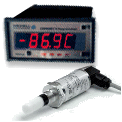
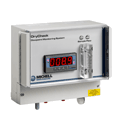
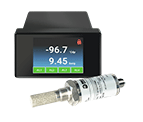
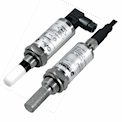
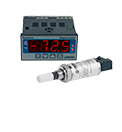
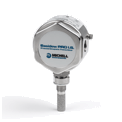
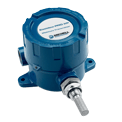
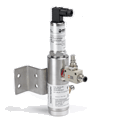
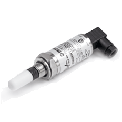
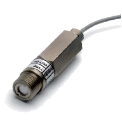
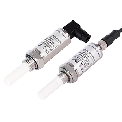
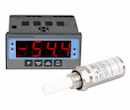
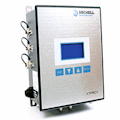
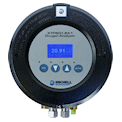
Products frequently used within the Compressed Air Industry
High levels of moisture in breathing air makes it uncomfortable to breath and increases the risk of bacteria growing in the system which is a potential health risk. If humidity levels are too high in the compressed air, there is a risk of moisture condensing. This can cause airlines to become blocked, or cylinders to corrode.
The European Standard EN12021:2014 “Respiratory protective devices – Compressed Air for breathing apparatus” states that the pressure dew-point should be equal to or less than 11°C, or 5 degrees lower than the lowest application or storage temperature.
Compressed air used to power pneumatic tools and conveyers must be clean and dry to avoid contamination of products and corrosion of the equipment. The ISO Air Quality Standard ISO8573 is the international standard which sets out the requirements for compressed air purity and covers particulates and oil as well as moisture contamination.
For class 2 compressed air, a pressure dewpoint (PDP) of -40°C or better is required and no liquid water is allowed.
In medicinal applications compressed air is used for both breathing and as instrument air. As well as concerns for corrosion and breathing comfort, avoiding bacterial growth is a major concern.
There are a number of standards established and 2 common standards are : UK Health Technical Memorandum HTM02-01 for purity specification for medical gas, which determines moisture content ≤67 vpm (≤0.05mg/L, atmospheric dewpoint of -46°C) and European Pharmacopoeia 5.0 for medicinal air ≤67 ppm (*pressures greater than 10 bar and temperature higher than 5°C)
In dental air applications there are a number of recommended standards and one common standard is the UK NHS Technical Memorandum HTM2022 Supplement 1, which determines moisture content ≤1020vpm (≤0.78 mg/L, atmospheric dewpoint of - 20°C)
There are direct contact and indirect contact standards for food grade air within the food processing & food packaging industry.
The commonly referenced standards are as follows:
- Compressed air that comes in to direct contact with food or beverage products should meet or exceed the ISO 8573-1:2010
- Compressed Air Purity Class 2 pressure dew point ≤-40 °C.
- Compressed air that comes in to indirect contact with food or beverage products should meet or exceed the ISO 8573-1:2010
- Compressed Air Purity Class 4 pressure dew point ≤+3 °C